
We’re excited to announce a significant milestone we’ve hit at Sonera: detection of magnetic muscle activity in real-world conditions using our custom sensor technology that is both small and contactless. This is significant because we’re showing for the first time ever that magnetomyography (MMG) signals can be detected in everyday environments – a capability that is only enabled by the novel sensors we built.
In our previous posts, we touched upon the advantages of MMG and how it can advance applications like gesture recognition and silent speech, but we did this work using bulky 3rd party magnetometers that had to be shielded. Now, we’re showing that there’s a viable path to enabling those applications in unshielded and wearable form factors like watches, glasses and earbuds.
The video below shows a demo of this capability.
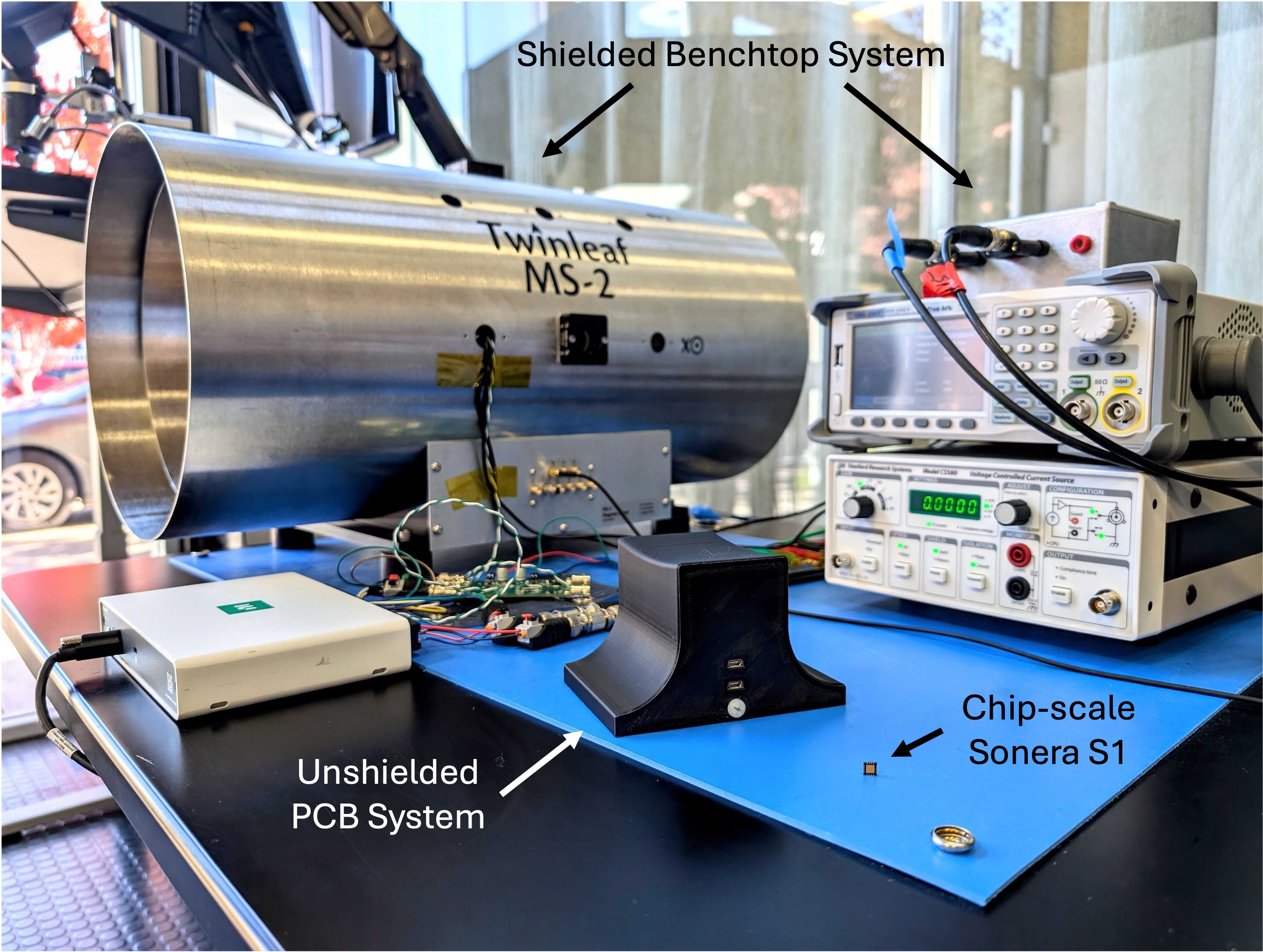
We’re detecting MMG here with two different systems – a shielded benchtop system and an unshielded PCB-based system (see image below). Both contain a small sensor element paired with larger read-out electronics that comprise the bulk of the size shown here. The eventual goal is to scale the entire system to a co-packaged chip, an example of which is pictured to the bottom right, by pairing the small sensor element with an ASIC for a total package size of 2x2 mm.
The operation of our sensors is based on the principle of magnetic resonance, but with a twist. Traditional magnetic resonance sensors use microwaves to excite resonance and detect magnetic fields. The use of microwaves is a pretty inefficient process – a lot of power and sensing volume are required for the sensor to operate.
What we’re doing instead is using a new class of magnetic materials called multiferroics, which leverage strong coupling between magnetic materials and sound waves to excite resonance with much higher efficiency. This lets us build a magnetic resonance-based sensor that is orders of magnitude smaller and lower power. We’re also doing it using materials and manufacturing processes that are well-established in the semiconductor industry today, meaning our technology can be produced in a way that makes it commercially viable at scale (we’re talking billions of sensors in various devices).
In order to enable MMG with our sensors, we spent many years improving the performance of our system such that the noise floor would be low enough to detect the very weak biosignals we’re reading from the body. For those familiar with magnetometers, the sensitivity we’ve reached to enable MMG is 600 fT/rt-Hz at 100 Hz. This performance level puts us among the most sensitive ambient magnetometers out there – and there’s room to bring that noise floor down even further.
Our sensors unlock the ability to measure MMG signals in real-world environments and naturalistic conditions. And because we’re doing this using a mass-manufacturable and contactless sensor, we can integrate our technology into wearable form factors in a way that feels invisible to the user. Ultimately, this means we can collect large amounts of high-fidelity biosignal data over long periods of time in many conditions, giving us new insights into human health and behavior.
This also brings us one step closer to building scalable non-invasive brain-computer interfaces. By using high-density arrays of our sensors and continuing to improve performance, we can make ambient chip-scale magnetoencephalography (MEG) possible, a technique that has been shown to significantly outperform traditional non-invasive neural imaging modalities like electroencephalography (EEG).
Finally, our technology open up totally new applications of high-performance magnetometry beyond biosignals - GPS-denied navigation, indoor positioning, geophysical exploration and low-field MRI are just a few examples of application spaces that are impacted by the advent of ultra-sensitive chip-scale magnetometers.
Stay tuned as we unlock more capabilities that simply aren't possible without our technology. For demos, partnership discussions, or evaluation queries, contact us at info@sonera.io.


